

Introduction
Hiring more people is supposed to make your business easier to run. You finally have help completing the work, serving more customers, and taking responsibilities off your plate.
But that is not always what happens.
Instead, your days can start filling with employee questions, scheduling problems, customer concerns, quality issues, missed information, and situations that eventually make their way back to you. You are no longer only responsible for doing the work. Now you are responsible for making sure everyone else can do it too.
At Transparent Transformations, I see this become a major transition point for service business owners. Hiring itself is often not the problem. The business grew, but the structure around the team did not grow with it.
If you have added employees, increased revenue, and still feel like you cannot step away, the issue may be less about how many people you have and more about the business you are asking those people to operate inside.
Hiring Creates Capacity, but It Also Creates Management
Hiring can absolutely increase what your business is capable of producing.
If you own a cleaning company, more cleaners allow you to complete more jobs. If you own a roofing company, another crew can increase the amount of work you can take on. If you run a renovation company, additional people can allow multiple projects to move at once.
But every person you add also creates new management responsibilities.
Your team needs to understand:
• What they are responsible for
• Where they need to be
• What information they need before starting
• What standard the work needs to meet
• What to do when something changes
• Who makes certain decisions
• How progress gets recorded
• When the customer should receive an update
• What needs to happen before a job is considered complete
When those answers are unclear, your team has to get them from somewhere.
Usually, they come to you.
That is why hiring can increase the amount of work your company produces while also increasing the amount of work you personally have to manage.
More people do not automatically create more freedom.
They create more freedom when the business has enough structure for those people to operate without needing you to constantly fill in the gaps.
Why Your First Few Employees Can Feel Manageable
The early stages of building a team can give you the impression that your current approach will continue working as the company grows.
When you hire your first employee, you can stay closely involved. If they have a question, they ask you. If something was missed, you notice it. If the customer needs an update, you can handle it yourself.
You may add a second employee and still manage things in roughly the same way.
At this point, it can feel like you are doing exactly what you are supposed to do. You have help. You can take on more work. Revenue may increase. You are no longer personally completing every single job.
The problem is that the business may still be operating almost entirely through your personal involvement.
You know which client needs an update. You remember which project is behind. You know what tomorrow’s schedule looks like. You know what one employee forgot. You remember which customer has not paid yet.
There may not actually be much structure holding those things together.
You are holding them together.
With one or two employees, you may have enough mental capacity to keep doing that.
As the team grows, that becomes much harder.
What Changes as Your Team Gets Bigger
Three employees are different from one.
Six employees are different from three.
A team of ten creates a completely different business than the one you were running when you were doing most of the work yourself.
Every new person creates more communication, handoffs, decisions, questions, responsibilities, and opportunities for something to be missed.
Before long, your day may include:
• Answering employee questions
• Solving scheduling conflicts
• Handling quality concerns
• Responding to unhappy customers
• Training people
• Hiring replacements
• Managing projects
• Reviewing completed work
• Sending estimates
• Following up with leads
• Dealing with administrative problems
• Stepping back into fulfillment when somebody does not show up
You can end up busier than you were before you hired anyone.
The difference is that your work has changed.
Instead of spending your entire day completing the service, you are now spending much of your time managing people and compensating for processes that were never clearly built.
You Were the Original System
This is one of the most important ideas to understand.
Many service businesses are not originally built around a formal process.
They are built around you.
That is completely normal in the beginning.
When you personally complete the work, you do not need an elaborate quality control process because you are the person protecting the quality.
You do not need written instructions explaining how you want customers treated because you are speaking with them yourself.
You do not need a project management system to tell you where a job stands because you already know.
You do not need a completion checklist because you are the person deciding whether the work is finished properly.
That approach can work extremely well when the business is small.
The problem appears when you start trying to transfer those responsibilities to other people.
Now the business has to answer a much harder question:
How does somebody else consistently produce the result that used to depend on you?
If the answer is still, “Ask me whenever you are unsure,” then you have hired help, but you have not actually reduced how much the business depends on you.
Hiring Cannot Fix a Business That Still Lives in Your Head
This is also where frustration with employees can start.
You hire someone hoping they will take responsibility away from you, but they continue coming back with questions.
Sometimes you may genuinely have the wrong employee.
But sometimes the employee is operating inside a business that has never clearly explained what they are supposed to own.
Think about what happens when:
• Project information is spread between text messages, email, paper, and your memory
• Nobody has clearly defined what happens after a job is sold
• Your team does not know when customers should receive updates
• Responsibilities change depending on who happens to be working that day
• Nobody knows exactly what a completed job should include
• There is no central place to see what is finished and what is still outstanding
• Quality is based on whether you personally notice a problem
Your employees may be capable people.
They simply do not have a structure that allows them to work independently.
A simple business road map can help you see where this is happening. Map the major stages from the moment someone becomes a lead through sales, scheduling, fulfillment, completion, and follow up. Then look for every point where the process stops, slows down, or becomes unclear unless you personally step in.
Those are often the areas keeping the business tied to you.
Why Quality Becomes Harder to Protect as You Step Away
There is another reason it can be difficult to delegate.
You care about the quality of the work.
If you spent years building your reputation around doing a good job, handing that responsibility to another person can feel uncomfortable.
You know how you would clean the property.
You know what details you would check before leaving a roofing job.
You know how you would finish the renovation.
You know how you would respond to a customer who has a concern.
Because you trust your own standard, it can feel safer to stay involved.
The problem is that this creates a ceiling.
If the only way to protect quality is for you to personally inspect, approve, correct, and communicate everything, then the amount of work the business can handle will always be tied to your capacity.
A better question is:
How can you define quality clearly enough that the business can protect it even when you are not there?
That is a very different problem to solve.
Your Customer Experiences More Than the Technical Work
Quality is also bigger than the technical service itself.
You may know exactly what separates excellent workmanship from average workmanship. Your customer often does not.
What they absolutely understand is their experience dealing with your company.
They notice whether:
• You communicate clearly
• Someone shows up when expected
• They know what is happening
• Problems are explained properly
• Questions are answered
• The process feels organized
• They can see evidence of the work being completed properly
Consider a roofing project.
The homeowner may not understand every technical decision involved in the installation. They probably cannot inspect the entire roof and determine whether every detail meets your standard.
But they can understand photos.
They can understand receiving an update when the old roof has been removed.
They can understand being shown an unexpected problem and having somebody explain what it means.
They can understand progress updates and final photos.
Technical quality still matters. But you also need to make that quality visible to the customer.
The same principle applies to cleaning, landscaping, renovations, maintenance, and many other service businesses.
Client communication is not separate from fulfillment.
It is part of the service you are delivering.
Project Management and Client Communication Are Different
These two areas are closely connected, but they solve different problems.
Project management is about making sure the work itself is organized.
You need visibility into:
• What needs to happen
• Who is responsible
• When it should happen
• What has already been completed
• What is still outstanding
• Whether there is a problem
• What needs approval
Client communication is about making sure your customer understands what is happening around that work.
They need to know things such as:
• What happens next
• When the work is scheduled
• Whether the schedule has changed
• Whether an unexpected issue has appeared
• What has been completed
• Whether you need anything from them
• Who they should contact with a question
You can have excellent internal project management and still provide a poor customer experience.
You can also communicate frequently with customers while your internal operations remain chaotic.
You need both.
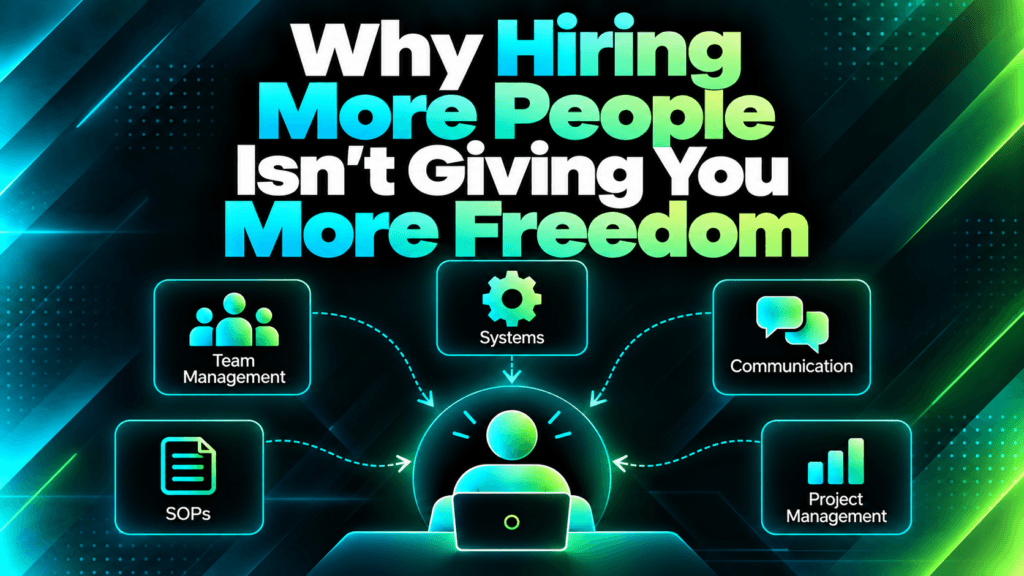
Three Core Systems That Can Help the Business Depend Less on You
You do not need dozens of applications or complicated processes to begin reducing how much the business relies on you.
For many service businesses, three areas provide a strong starting point.
1. A CRM for Client Communication and Sales
CRM stands for customer relationship management.
At its simplest, a CRM gives you one place to organize relationships with leads and customers.
That may include:
• New inquiries
• Estimates
• Sales opportunities
• Follow up
• Emails and text messages
• Appointments
• Agreements
• Different stages of your sales process
The specific software matters less than the principle behind it.
Important customer information should not live exclusively inside your personal phone or memory.
Imagine you currently have five people who received estimates but have not made a decision.
If those opportunities only exist in your head, you are probably the person who has to remember to follow up.
If they exist inside an organized system with a clear process, somebody else can potentially see who needs to be contacted and take responsibility for it.
Now the work is becoming transferable.
2. Project Management for the Actual Work
Once somebody becomes a customer, the project needs somewhere to live.
Your team should be able to find basic information without asking you every time.
That could include:
• Customer name
• Project location
• Scheduled dates
• Assigned team members
• Tasks
• Notes
• Photos
• Outstanding issues
• Current project status
The goal is visibility.
If an employee needs to call you every time they want to know what is happening with a project, then the project is still running through you.
3. SOPs for How the Work Should Happen
SOP stands for standard operating procedure.
That term can sound far more complicated than it needs to be.
You do not need to begin by writing a hundred page operations manual.
A useful SOP can start with a simple set of checkpoints.
For example, a completion process might include:
- Confirm all required work has been completed
- Perform the final quality check
- Take completion photos
- Update the project status
- Send the customer a completion update
- Confirm any outstanding payment
- Request a review when appropriate
That is already a system.
You can make it more detailed as the business grows.
The goal is not to document every movement an employee makes.
The goal is to make it clear what needs to happen for the responsibility to be completed correctly.
Build Client Communication Into Your Processes
One thing I would pay particular attention to is where communication happens inside your SOPs.
A lot of businesses are good at documenting the technical work.
They are less intentional about documenting when the customer should hear from them.
Imagine you create a detailed roofing process explaining exactly how the roof should be installed, but nowhere in that process does it say when the homeowner receives an update.
The crew may do excellent work while the customer spends the entire day wondering what is happening.
You can fix that by making communication part of the process itself.
For example:
Before the job: Confirm the arrival window.
After tear off: Send an update and relevant photos.
If unexpected damage is discovered: Explain the issue before additional work moves forward.
At completion: Provide final photos and explain any remaining next steps.
Now communication is no longer something you personally have to remember.
It is part of how the work gets done.
Good Systems Should Reduce Thinking
There is a point where systems can become unnecessarily complicated.
If you are already overwhelmed, the last thing you need is a 47 step procedure for something that could be explained in six checkpoints.
Start with one question:
What does another person need to know to complete this responsibility correctly without having to come back to me?
Then give them that information in the simplest useful format.
Sometimes that is a checklist.
Sometimes it is a short written process.
Sometimes it is a video.
Sometimes it is a workflow inside your project management system.
You can make the system more detailed later if the business actually needs more detail.
This is also where good consulting should help simplify what needs to happen rather than burying you under another list of systems to build. The goal is to identify which processes are creating the most dependency on you and work through those first.
The Goal Is to Gradually Outsource Yourself
This does not mean replacing yourself or disappearing from the company.
It means taking responsibilities that currently depend entirely on you and making them transferable.
Consider sales follow up.
Right now, maybe you personally remember which unsigned estimates need another call.
To make that responsibility transferable, you would define:
• Who needs follow up
• When they should be contacted
• How often follow up should happen
• What should be said
• Where the result gets recorded
Once those pieces are clear, another person can potentially own that responsibility.
You can apply the same idea to:
• Scheduling
• Customer updates
• Quality checks
• Project setup
• Review requests
• Employee onboarding
• Administrative follow up
• Job completion
Every responsibility you make transferable reduces the number of things that can only happen because you are personally involved.
That is how you gradually create more space for yourself.
You Do Not Need to Stop Doing the Work You Enjoy
Building systems does not mean you have to remove yourself from every part of your company.
You may genuinely enjoy aspects of fulfillment.
You might own a roofing company and still enjoy spending some time on jobs.
You may run a cleaning company and still want to occasionally work alongside your team.
There is nothing wrong with that.
The important distinction is choice.
There is a major difference between saying:
I am involved because I want to be.
And:
I have to be involved because the business cannot operate properly without me.
Freedom does not have to mean doing nothing.
It means having more control over what deserves your time.
Where Should You Start?
If everything still seems to come back to you, do not respond by trying to systemize the entire company this weekend.
Pick one recurring problem.
Think about the responsibilities your team constantly brings back to you.
Maybe employees repeatedly ask what happens after a job is sold.
Maybe all customer updates still come from you.
Maybe nobody knows exactly when a project is considered complete.
Maybe leads are only followed up with when you remember.
Choose one.
Then ask yourself:
- What keeps coming back to me?
- What information or decision am I providing every time?
- Can that become a checklist, process, workflow, or clear rule?
- Who could take ownership of it once the process is clear?
That is a much more manageable way to reduce dependency on you.
You are not trying to fix the entire business at once.
You are taking one responsibility that currently requires you and building a better way for the business to handle it.
Conclusion
Hiring more people can help your business grow, but hiring alone will not give you more freedom.
If the information, processes, quality standards, customer communication, and decisions still live primarily with you, every new employee can create another person you have to manage instead of another person who can genuinely take responsibility.
The goal is not simply to build a bigger team.
It is to build a business where the team has enough clarity to operate.
Start by looking at the things that repeatedly come back to you. Identify what your team is missing, whether that is information, a process, a clear expectation, or a place to track the work. Then begin moving that knowledge out of your head and into the business.
You do not need to remove yourself from everything.
You need to stop being the only person who can keep everything moving.
If you are growing your team but still feel like every problem eventually lands back on your desk, reach out. We can look at how your business currently operates, identify where it depends too heavily on you, and determine what needs to be built first.