



Introduction
Client work is one of the most important parts of running a service-based business. It keeps revenue coming in, gives clients a reason to stay, and helps you build a strong reputation.
The problem begins when client work takes over every available part of your week.
You spend your days answering questions, completing projects, handling calls, fixing problems, and responding to last-minute requests. By the time the client work is finished, there is little energy left for sales, marketing, administration, planning, or improving how the business operates.
You remain busy, but the business does not become easier to run.
Stopping client work from taking over does not mean giving clients less care. It means creating enough structure around delivery so you can serve them well without allowing every request to control your calendar.
Client Work Will Expand Into the Time You Give It
Client work rarely arrives in a perfectly organized block.
A message comes in while you are working on something else. A project takes longer than expected. A client asks for a small addition. A meeting runs over. One unfinished task spills into the following day.
Without clear boundaries, client work expands until it fills the whole week.
You may begin Monday with a reasonable plan and reach Friday without touching anything outside delivery. Marketing gets delayed, leads do not receive follow-ups, invoices remain unfinished, and improvements you wanted to make are pushed into another week.
This happens because immediate client needs feel more urgent than internal business work. A client is waiting, while your systems, planning, and marketing can technically wait.
But when those internal tasks are repeatedly delayed, the business becomes more dependent on you.
Being Fully Booked Is Not the Same as Being in Control
A full calendar can look like success.
You may have several clients, steady revenue, and enough demand to remain busy. From the outside, the business appears to be working.
Internally, you may feel like you have no control over your own time.
You react to the calendar instead of designing it. Every open block becomes available for another call, project, revision, or request. You may even feel guilty protecting time that is not directly connected to a paying client.
A busy schedule only helps when the work is organized around the business you want to build.
When your calendar leaves no room to follow up with leads, improve your service, review finances, or think about the future, being fully booked may be limiting your growth instead of supporting it.
Know How Much Delivery You Can Actually Hold
One reason client work takes over is that many owners do not know their real delivery capacity.
You may continue accepting clients because there is technically space in the calendar. But an open hour does not always mean you have the capacity for another client.
Every client can create work beyond the scheduled appointment or project. You may also need time for:
- Preparation
- Communication
- Revisions
- Notes and documentation
- Invoicing
- Follow-ups
- Problem-solving
- Travel
- Recovery after demanding conversations
When you only measure the visible delivery time, you consistently underestimate the amount of space each client requires.
Review your current workload and estimate how much total time each client or project takes from beginning to end. Include the work that happens before and after the scheduled delivery.
This gives you a clearer picture of how many clients you can serve well without turning every week into a recovery exercise.
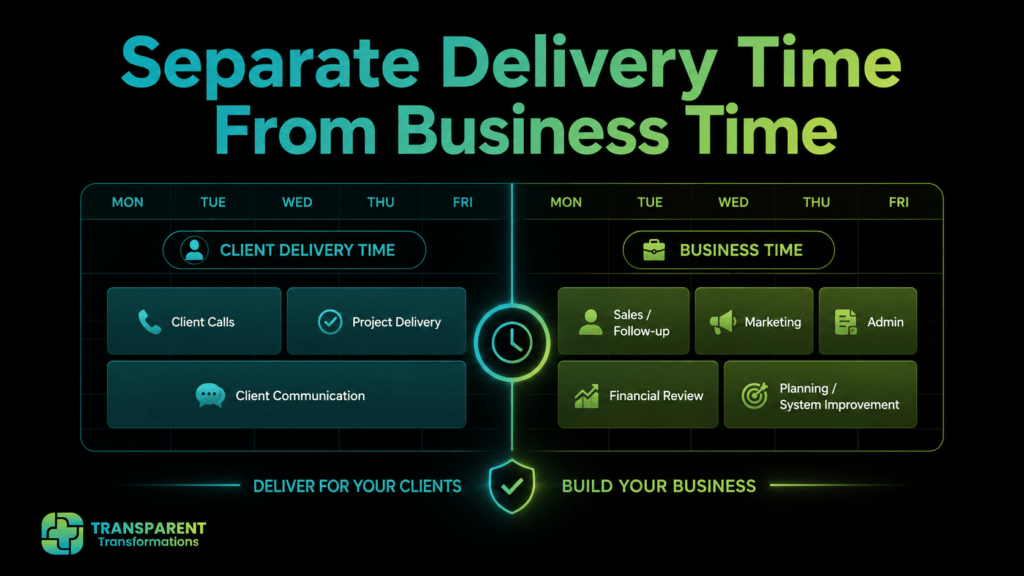
Separate Delivery Time From Business Time
When every type of work shares the same calendar, the most immediate task usually wins.
You begin the day planning to follow up with leads, review your finances, or improve your onboarding process. Then a client message arrives, and the entire block disappears into delivery.
You need to separate the time used to serve current clients from the time used to operate and grow the business.
Your week may need clear blocks for:
- Client calls
- Project delivery
- Client communication
- Sales and follow-up
- Marketing
- Administration
- Financial review
- Planning and system improvement
The exact schedule will depend on your business. The important part is that client work does not automatically receive every open hour.
Business time should be treated like a real commitment. Protecting it helps you build the structure your clients and your business depend on.
Stop Treating Every Message Like an Emergency
Client communication can quietly break your entire week into small, unusable pieces.
You may check messages while writing, respond to emails between calls, or interrupt focused work every time a notification appears. Each reply may only take a few minutes, but the repeated interruptions make it difficult to complete anything that requires sustained attention.
Clients do not usually need constant access. They need clear expectations and reliable responses.
Set specific times to review and respond to client communication. You might check messages once late in the morning and once before the end of the workday.
You can also tell clients:
- Which communication channel to use
- When you normally respond
- What should be considered urgent
- What support is included
- Where they can find common information
Clear communication boundaries reduce uncertainty for both sides. The client knows when to expect a response, and you stop rebuilding your attention throughout the day.
Create a Clear Client Process
Client work becomes harder to manage when every client receives a different process.
You may remember that one person needs a follow-up, another needs an invoice, and another needs a document before the next session. When each client journey lives in your memory, delivery becomes mentally exhausting.
A clear client process reduces the number of decisions you need to make.
Map the main stages of your service, such as:
- Initial inquiry
- Consultation
- Payment
- Onboarding
- Service delivery
- Follow-up
- Renewal or completion
Then create a simple checklist for each stage.
This could include sending an onboarding form, scheduling the next appointment, preparing the necessary files, updating your records, and sending the final follow-up.
The goal is not to make client service feel robotic. It is to remove repetitive decisions so you can focus more fully on the person or project in front of you.
Use Templates for Work You Repeat
You may be doing more manual work than your service requires.
When you regularly write similar emails, create the same documents, explain the same next steps, or send the same reminders, those tasks can often be simplified.
Useful templates may include:
- Welcome emails
- Appointment reminders
- Session follow-ups
- Project updates
- Payment reminders
- Frequently asked questions
- Client checklists
- Completion emails
- Renewal messages
A template should give you a reliable starting point. You can still personalize it where needed.
This saves time without lowering the quality of the client experience. It can also improve the experience because important details are less likely to be forgotten.
Give Client Work a Clear Beginning and End
Client work can take over your week when there is no clear definition of what is included.
A project begins with one outcome, but small additions continue appearing. A client asks for a quick favour, then another. You agree because each request seems minor, but together they expand the work far beyond what you originally planned.
Your service needs clear boundaries.
Before work begins, define:
- What is included
- What is not included
- How many revisions are available
- How communication will work
- When the work will be delivered
- What happens when the scope changes
- What additional work will cost
This is especially important when you care deeply about your clients. Your desire to help can make it difficult to notice when support has quietly become unlimited access.
Clear scope protects your calendar and helps the client understand exactly what they are purchasing.
Build Space Between Client Commitments
A calendar packed with back-to-back delivery may appear efficient, but it leaves no room for delays, notes, preparation, or recovery.
One meeting runs late, and the rest of the day falls behind. A client brings up an unexpected issue, and you carry that conversation directly into the next appointment. By the end of the day, you may have completed the calls but still have several unfinished tasks connected to them.
Build space around demanding client commitments.
You may need:
- Fifteen minutes before a call to prepare
- Fifteen minutes afterward to complete notes
- A longer break after several consecutive meetings
- A buffer block for work that takes longer than expected
- One day with fewer client commitments
You do not need to maximize every hour. You need a week that can handle normal interruptions without falling apart.
Protect One Block for Improving the Business
Client work keeps the business operating today. Systems work helps it operate better tomorrow.
Without protected improvement time, the same problems continue repeating. You keep writing the same emails, fixing the same mistakes, searching for the same files, and handling the same avoidable questions.
Set aside one recurring block each week to improve how the business runs.
During this time, you could:
- Improve your onboarding process
- Create a template
- Organize client files
- Automate a reminder
- Update your service process
- Review recurring client problems
- Document a repeated task
- Simplify your calendar
Choose one improvement at a time.
You do not need to rebuild the entire business in one afternoon. Remove one source of pressure each week so the business gradually becomes easier to manage.
Build a Clear Roadmap for Your Week
A calendar filled with tasks does not automatically create a useful week.
You need a clear roadmap for what the week is meant to accomplish beyond completing whatever appears next. Without one, client requests can quickly become the default priority.
At the beginning of the week, identify:
- The most important client commitments
- The leads that need follow-up
- The administrative work that cannot be delayed
- The marketing task that needs to be completed
- The one business improvement you want to make
- The blocks that must remain protected
Your roadmap does not need to account for every minute. It should show you where your time needs to go and which responsibilities cannot continue being pushed aside.
You can still adjust when something important changes. The difference is that you are adjusting an existing plan instead of rebuilding your week every time someone contacts you.
Do Not Use Evenings to Repair an Overbooked Week
When client work takes over the day, business owners often move everything else into the evening.
You finish delivery and then try to send invoices, create content, update the calendar, follow up with leads, and plan the next day after everyone else has stopped working.
This may solve the immediate problem, but it teaches the business that your personal time is available whenever the schedule becomes overloaded.
Eventually, the week has no clear end.
Evening work may occasionally be necessary, but it should not be the system holding the business together. When you repeatedly need nights or weekends to catch up, the daytime schedule needs to change.
You may need to reduce delivery, increase prices, improve the process, shorten meetings, set stronger boundaries, or stop accepting work that does not fit your capacity.
Recognize When the Problem Is the Offer
Sometimes client work takes over because the service itself is too demanding.
You may be offering too much access, too many revisions, excessive customization, or work that cannot be delivered efficiently at the current price.
The issue may not be time management. It may be how the offer was designed.
Review your service and ask:
- Which part takes the most time?
- Which part creates the most interruptions?
- What do clients regularly misunderstand?
- What work is being added without additional payment?
- What could be standardized?
- What should become an optional add-on?
- Does the price reflect the full delivery requirement?
A better offer creates a clearer experience for the client and a more manageable workload for you.
Consulting Can Help You Build a More Sustainable Week
When you have worked inside the same routine for a long time, an overloaded week can begin to feel normal.
You may assume that constant client communication, evening administration, and unfinished internal work are simply part of running a business. Because you are still delivering for clients, it can be difficult to see how much the current structure is limiting your growth.
This is where business consulting can help.
A consultant can review how your time is being used, identify the systems or boundaries that are missing, and help you decide what needs to change first.
The goal is to create a practical structure that allows you to serve clients well without making yourself constantly available.
What to Do This Week
Start by reviewing the last full week of your calendar.
Do not rely only on what was scheduled. Include the client messages, preparation, follow-ups, revisions, and unfinished tasks that happened around the visible appointments.
Write down:
- How many hours were spent on direct client delivery
- How much additional time delivery created
- Which interruptions happened repeatedly
- What business tasks were delayed
- Which client requests fell outside the original scope
- What work could be templated or automated
- Which block needs to be protected next week
- One boundary you need to communicate
Then choose one change.
You might create two communication windows, protect a weekly operations block, add buffers between calls, clarify your service scope, or stop scheduling client work during a specific part of the week.
Make the change small enough to use immediately.
Conclusion
Client work should be a major part of your business, but it should not control every part of your week.
When delivery expands without clear limits, sales, marketing, administration, planning, and personal time are pushed aside. The business stays busy but becomes increasingly dependent on your constant effort.
Start by understanding your true capacity, separating delivery from business time, setting clearer communication boundaries, and improving one repeated process at a time.
The goal is to create a structure that allows you to serve clients well without losing control of the business you are building.
If you have questions or want support with this, fill out the form and our team at Transparent Transformations will be happy to get back to you.