


Introduction
Your business can be making money and still feel messy behind the scenes. Clients are paying, work is getting done, and from the outside it may look like things are going well. But inside the business, you feel pulled in every direction. You are trying to remember tasks, respond to clients, manage delivery, follow up with leads, fix problems, and still find time to think about growth. The issue is usually not that the business is failing. It is that the business has grown past the structure currently holding it together.
Revenue Can Hide a Messy Business
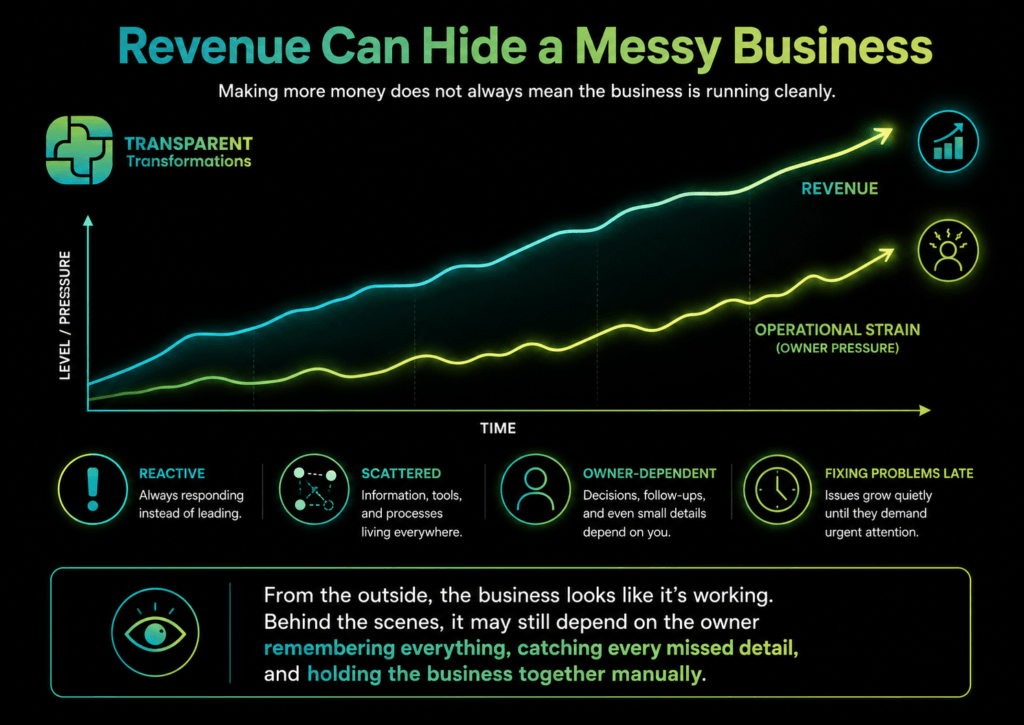
Making money can make it feel like the business is more organized than it actually is. If clients are paying and work is getting delivered, it is easy to assume the business is fine. But revenue does not always mean the business is running cleanly.
A service-based business can bring in money while still feeling reactive, scattered, and overly dependent on the owner. You may be the one remembering every task, catching every missed detail, replying to every client, and fixing every issue before it becomes a bigger problem. That can work for a while, but eventually the pressure starts to show.
This is where a lot of owners feel confused. The business is technically working, but it does not feel calm, organized, or easy to manage. It feels like everything stays together only because you keep forcing it to.
You May Have Outgrown the Way You Started
Most service businesses start with a simple rhythm. You get a client, do the work, send the invoice, follow up when needed, and keep track of things wherever you can. In the beginning, that loose structure can work because there are fewer moving parts.
Then the business grows. You have more clients, more conversations, more deadlines, more payments, more follow-ups, and more decisions to make. The same casual system that helped you start the business begins to create stress because it was never built to hold this much weight.
That does not mean you built the business wrong. It means the business needs a stronger roadmap than it needed at the beginning. What worked when things were smaller may now be the reason everything feels harder to manage.
The Owner Becomes the System
A business feels messy when too much of it depends on what you remember. You know which client needs an update, what lead needs a follow-up, what invoice needs to be sent, what task is half-finished, and what problem needs to be handled next. But if all of that information only lives in your head, the business is not being supported by a system. It is being supported by you.
That creates pressure because you are not only doing the work. You are also acting as the reminder, planner, project manager, admin person, salesperson, and problem-solver. Even if you are good at all of those things, it becomes exhausting when everything has to pass through you.
A business that runs from the owner’s memory often leads to:
- Missed follow-ups
- Late replies
- Forgotten tasks
- Inconsistent client experience
- Last-minute decisions
- Mental overload
- Difficulty delegating
- No clear view of what matters most
The first step is to get the business out of your head and into something visible. You need to be able to look at the business and see what is happening without mentally carrying every detail.
Client Work Can Take Over the Whole Week
Client work matters because it is what people are paying you for. The problem starts when client delivery fills every available space in your week. When that happens, the business may stay busy, but the parts that help it run better get pushed aside.
Follow-ups slip because you are delivering. Marketing becomes inconsistent because you are delivering. Admin piles up because you are delivering. Systems never get built because every open pocket of time gets swallowed by more client work.
This is one of the most common traps for service-based business owners. The work that brings in money also becomes the thing that blocks the business from becoming more organized. If there is no protected time to improve how the business runs, the mess continues.
You need space for both delivery and operations. Doing great work for clients matters, but so does building the structure that allows the business to run without consuming your whole week.
Growth Without Structure Creates More Pressure
Growth sounds good until the business is not ready to hold it. More clients can mean more income, but they also bring more communication, more expectations, more deadlines, more decisions, and more places for things to slip. If the business does not have enough structure, growth can make everything feel heavier.
This is why some owners start making more money but do not feel more free. They expected growth to create breathing room, but instead it created a busier version of the same chaos. The business added more demand before it added more support.
That support could be a better calendar system, a clearer client process, stronger boundaries, a simple task management system, or a weekly operating rhythm. This is also where consulting can be useful when the owner is too close to the business to see what needs to change first.
The goal is not to add more complexity. The goal is to build enough structure so growth does not automatically turn into more pressure.
You Need a Clear Weekly Operating Rhythm
If your business feels messy, start with the week. Most owners do not need to rebuild the whole business overnight. They need a consistent time to look at what is happening, what is slipping, and what needs attention before everything becomes urgent.
A weekly operating rhythm gives you a simple way to review the business instead of running it completely from memory. Once a week, you can look at client work, leads, follow-ups, invoices, admin, marketing, and any problems that keep repeating. This helps you see the business more clearly instead of constantly reacting to whatever is in front of you.
A weekly reset could include:
- Current client work
- Upcoming deadlines
- Leads and follow-ups
- Payments and invoices
- Admin tasks
- Marketing tasks
- Problems that keep repeating
- One system that needs to be improved
This does not need to take hours. Even 30 to 60 minutes can make the business feel more stable because you are no longer waiting for problems to force your attention.
Build One Simple System at a Time
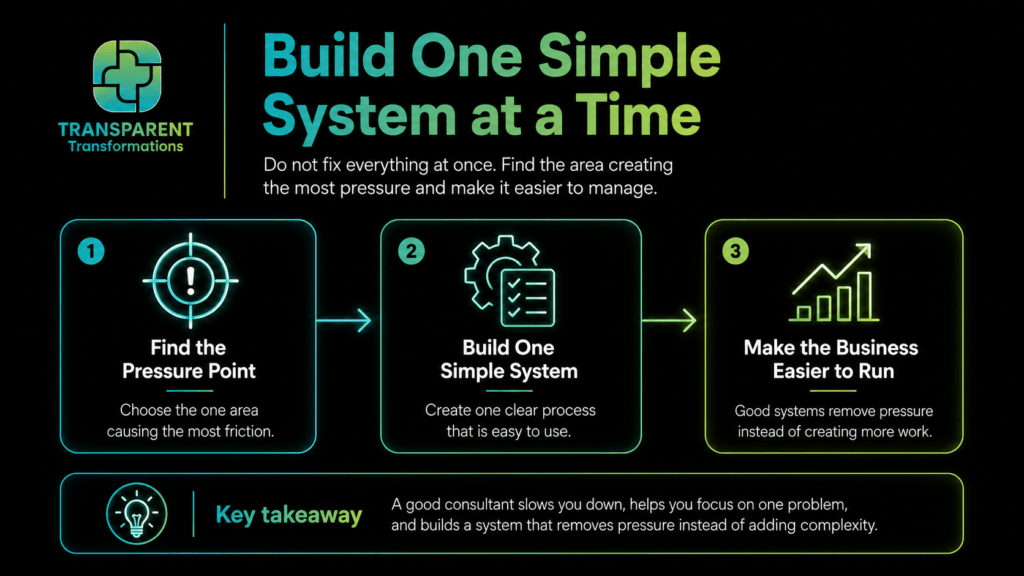
A messy business can make you want to fix everything at once, but that usually creates more confusion. The better move is to choose the area causing the most pressure and build one simple system around it. You are not trying to make the business perfect. You are trying to make it easier to run.
If follow-up is the issue, create one place to track every lead and the next follow-up date. If client delivery is the issue, create a simple checklist for each stage of the process. If your week feels chaotic, create a Monday reset where you review the business before jumping into delivery.
This is where a good consultant would usually slow you down instead of telling you to do more. The first fix is rarely to add ten new tools, ten new goals, or ten new processes. The first fix is to find the one part of the business that keeps creating pressure and make it easier to manage.
A good system should remove pressure, not create more work. If the system is harder to maintain than the problem it was meant to solve, it is too complicated.
What To Try This Week
Start by looking at where the business feels messiest right now. Do not try to fix every area at once. Choose one pressure point and create a small structure around it.
Ask yourself:
- What keeps slipping?
- What am I always trying to remember?
- What task keeps getting pushed back?
- What problem keeps repeating?
- What part of the business depends too much on me?
- What would make next week easier to run?
Then choose one small fix. That could be creating a client tracker, setting up a weekly reset, blocking time for admin, writing down your delivery process, or creating a simple follow-up list. The first step is not to make the business perfect. The first step is to make the business easier to see.
Conclusion
If your business feels messy even though it is making money, it usually means the business has grown past the structure you started with. Revenue may be coming in, but if everything depends on your memory, reaction, and constant effort, the business will keep feeling heavier than it needs to. Start by getting the business out of your head, creating a weekly operating rhythm, and building one simple system around the area causing the most pressure. If you have questions or want support with this, fill out the form and our team will be happy to get back to you.